
To make sense of their world, painters paint, photographers photograph, and knitters knit…sometimes with more purpose than at other times, sometimes for the process, sometimes for the product. The Pussyhat Project (clever women), is definitely with a purpose—to wit, knitting and crocheting pink hats for every single woman marching on Washington D.C. on January 17, 2019, as a show of solidarity with women and for women’s rights. Women from all over the nation will be descending upon Washington, and the hats represent all those who are there in spirit. The hat is a simple rectangle knit on both sides. You can drop off the hats at Love.Yarn.Shop. and we will get them on a woman’s head at the march.

As Advent season approaches, what am I thinking about? My Advent box sitting in the basement. No children to open the little doors each morning, their little fingers pulling out the surprise, their faces full of anticipation. My husband won’t play (I can see his face, disapproving with a hint of pity), and what’s the fun in hiding it for yourself? So I’ve carted it to the yarn shop and decided to hide a little treat or accessory in it each morning and one lucky customer will get to open it each day. How will I choose the customer? Ah, that will be my secret, but random, timetable. ’Tis the season…

Last night, after the 7th night of lying awake worrying about things beyond my control, I decided to make two lists: Things I Can Control, Things I Can’t Control. I don’t know about you, but making lists always makes me feel like I have a handle on my life and that I’m moving forward, one item at a time (especially if it’s a list where I can cross things off). So in my realm of “things I can control,” I firmly placed “anxiety.” To that end, two activities nestled into place: daily knitting and coloring. I know many people are coloring, but it wasn’t until “I Dream of Yarn,” A Knit and Crochet Coloring Book, crossed my doorsteps that I thought, “perfect.” Sometimes knitting or crocheting is just beyond my energy level, but coloring? I can curl up with a new box of crayons and a new illustration for a few restful moments. And if I can’t still my mind, the sound of snapped crayons might just ease the tension.

I was fortunate on my recent visit to England to attend Yarnporium at King’s College in London. This festival is small by American standards; held in The Great Hall, it accommodated 30 vendors and spotlighted 10 indie dyers. However, it was an educational experience for me, for here I found companies who cared deeply about preserving and promoting British Breeds. Blacker Yarns from Cornwall has breed-specific yarns: Blue-faced Leicester (who knew it was so soft?), Gotland, Hebridean/Mohair, Jacob, and Shetland. One yarn I brought back, Tamar, is 30% Cornish Mule (yes, baby soft mule fibre) blended with the long staple breeds Teeswater, Wensleydale, and Leicester Longwool. Baa Ram Ewe (aptly named after the Babe lines Baa-ram-ewe, Baa-ram-ewe! To your breed, your fleece, your clan be true! Sheep be true! Baa-ram-eye!) featured their yarn Dovestone. This luscious yarn from Yorkshire is made of 50% Bluefaced Leicester, 25% Wensleydale Longwool, and 25% Masham. The merino used in Alpaca Delight from John Arbon Textiles is from the Falkland Islands. Desiring to keep the wools British, the Falklands offer the dry climate Merino need to thrive. Britain still doesn’t enjoy the knitting culture that has grown up in America, but these last six years since the Prince of Wales launched the Campaign for Wool, the industry has seen great strides and Yarn in the City’s Yarnporium is one of them. May they have many more successful events!
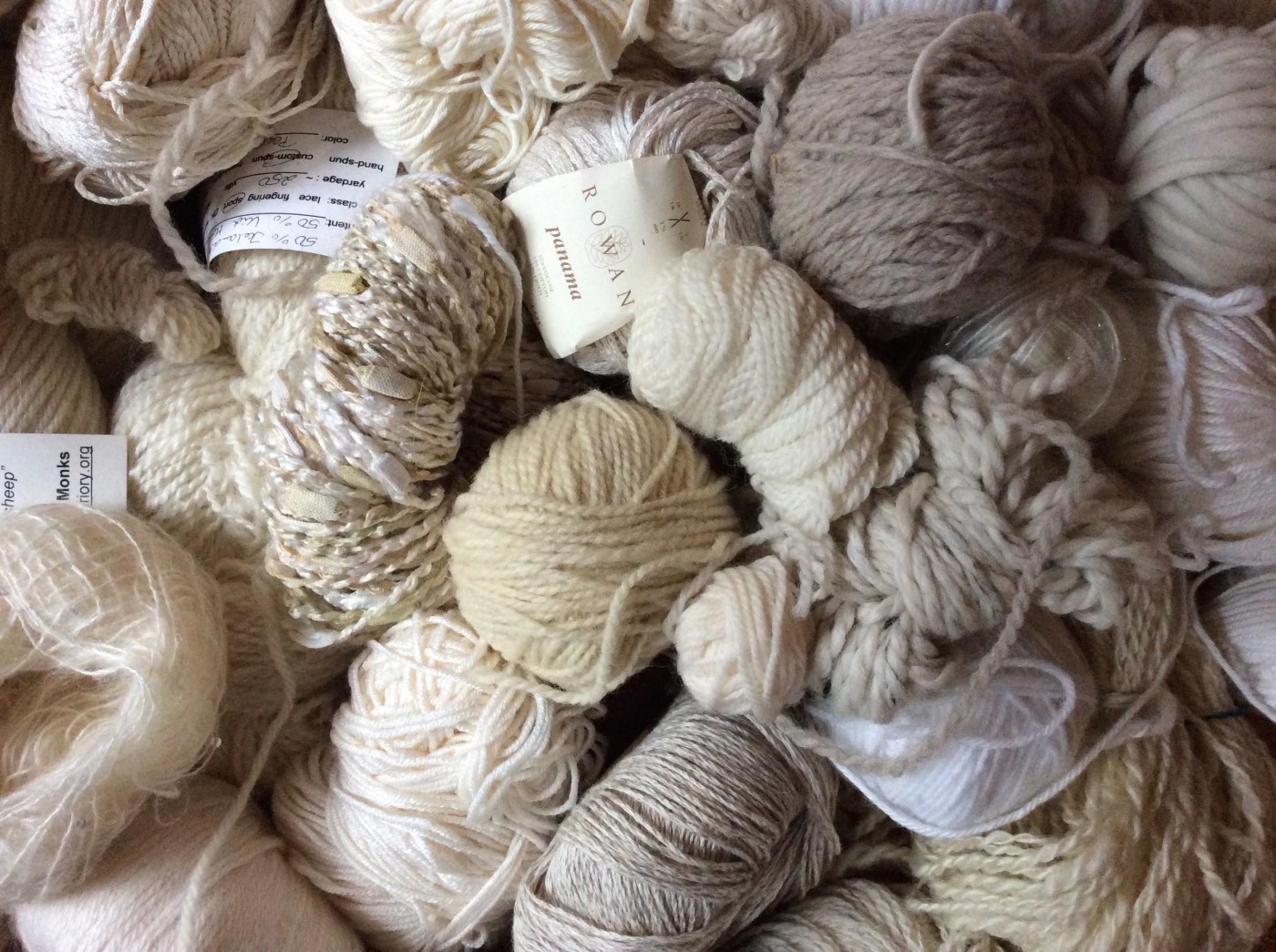
Working with yarn is a sensual experience. Some people like the softest yarns: cashmere, alpaca, merino. They gently stroke the fiber. Some like the wool that still smells of the sheep. They’re the ones that pick up the skein and stick their noses in it. Most drink in the colors with their eyes—color-therapy. It’s no surprise that crafting with yarn has grown in popularity as a therapeutic activity. There is no doubt that it increases your endorphins, and if we assume it has the same effect as laughter, then even the anticipation of working with yarn increases your endorphins: making you happier and less stressed.
Now, to the subject of the private yarn stash. On a regular basis, customers share with me information about their yarn stash. Many tell me they have more yarn in their personal stash than I do in the shop. I believe them. After all, I have a small shop. Some keep their stash in plastic totes, some in cedar closets (I wish!), some on shelves behind glass doors like a private library. All that yarn. If left on its own too long it will start to entwine with the other yarn and soon you will have a chaotic orgy of yarn. So it needs to be managed. Separated into color or weight, re-rolled, bagged, touched, prioritized.
What I want you to do, though, is embrace it. Yarn is therapy. Bring it out of the closet, enjoy it. Find stash-buster projects and plan ahead. This morning I took out all my naturals, which I am collecting to make a shawl. Every time I go to a festival or another yarn shop, I buy a natural yarn for this project. When will I make it? When the time is right. How will I know? I will begin. In the meantime, just the anticipation makes me happy, and that, as the Master Card ad says, is priceless.
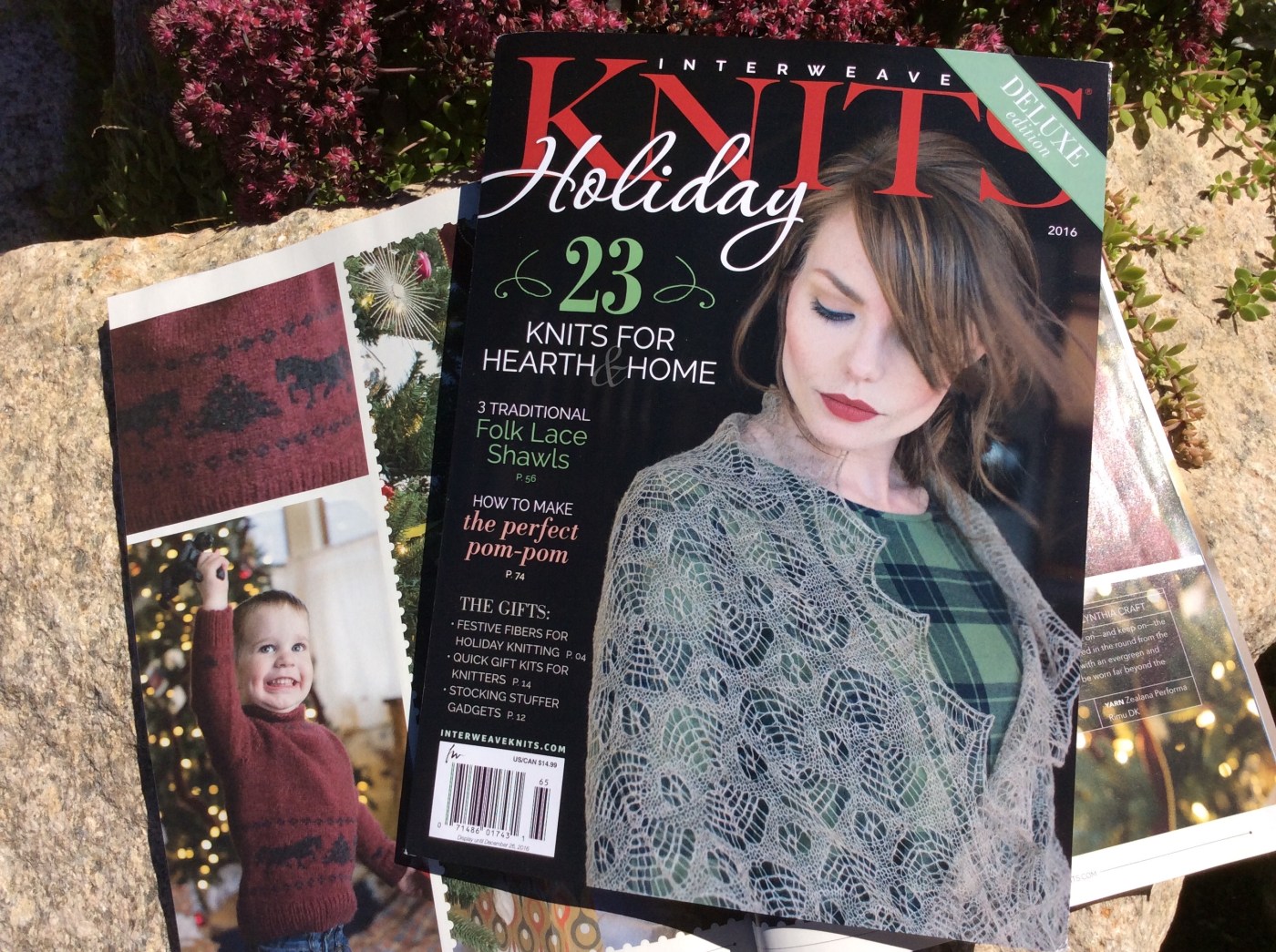
Is is wrong to want grandchildren just so I can knit for them? The new Interweave Holiday Knits has some irresistible patterns for the little ones; colorwork embellishes the little sweaters, dress, jumper and earflap hat. I was particularly taken with the dress and stocking patterns to partner with Jan Brett’s children’s books. In addition, the issue has all the small projects one might want to make before Christmas: a snowman ornament, several stockings, socks, mittens, and hats. As expected, Interweave has put together a great Holiday issue.

Vogue has a new look and deserves a new look if you are one of these knitters who found it too esoteric, filled with patterns both complicated and “vague” (an epithet for Vogue characterizing the sometimes difficult-to-follow patterns found within). This fall issue debunks any previously-held biases against the magazine. Full of wonderful articles on the Shetland Isles’ traditions and history, Fair Isle patterns for both large and small projects, and a section dedicated to patterns for men, it makes me wish I could claim Scottish roots. Alas, I’ll just have to remain a Scotophile and continue knitting fair isle.
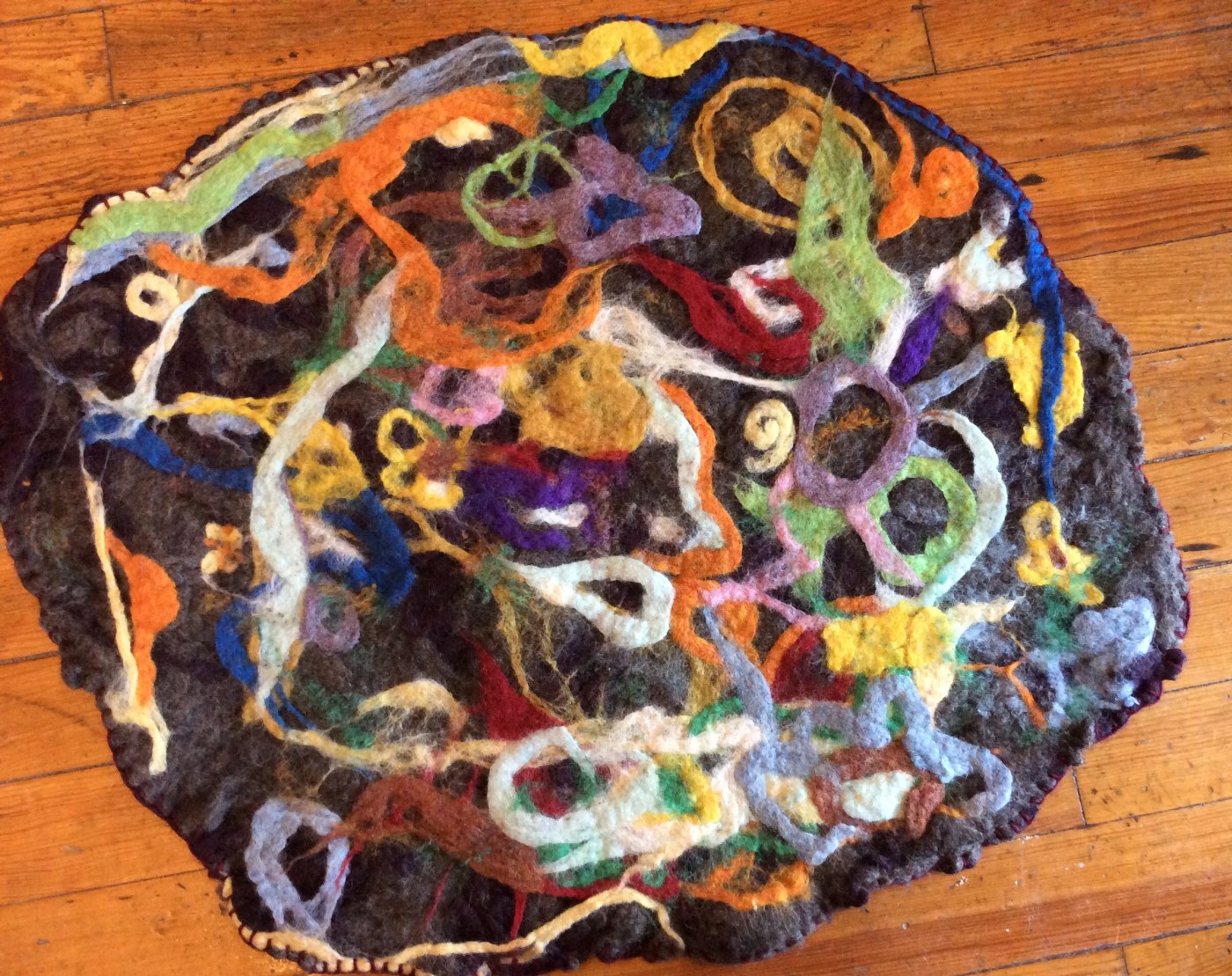
It’s who we are. During the Bethlehem Art Walk, Love.Yarn.Shop. was creating a felted community rug in a paddling pool outside the shop. Many thanks to the folks, young and not-as-young, who popped by to contribute to the rug. It takes a lot of rolling, pounding, and just plain hard work to convince the fibers of roving to become one…similar to a community. All the individual strands need to join together to become strong enough to create something bigger, sturdier, more resilient, and ultimately more appealing. Certainly the rug is a metaphor for the diverse community of Bethlehem and hopefully a symbol for its future—colorful and artistic, but still a little rustic around the edges.

I love fair isle. No apologies. So this issue, with its steeked man’s vest (which I plan to make for myself) and article on steeking by Mary Jane Mucklestone, make it a must-buy issue. (Plus, I have recently stocked Elemental Affects USA Shetland fingering which is perfect for steeking.) This is the 20th year anniversary edition, so it is loaded with great sweater, sock, and shawl patterns. For what is basically the cost of one pattern, you are getting a pattern book chock-a-block full of fantastic patterns. Seven of the patterns have color work and most of the others have cabling or textured stitches of one kind or another.
 Love.Yarn.Shop.